Evaluating Highest And Best Use For Ojai Main Street
July 2, 2026
July 2, 2026
If you own property on Ojai Main Street, the highest rent on paper is not always the highest value in practice. In a downtown shaped by walkability, historic character, visitor traffic, and tight land use rules, the best use of a building often depends on how well it fits the street, not just the spreadsheet. This guide walks you through how to evaluate highest and best use in Ojai with a practical lens so you can make clearer decisions about leasing, repositioning, or long-term value creation. Let’s dive in.
Highest and best use is a framework used to evaluate what use of a property creates the greatest value. The Appraisal Institute describes the analysis around four core tests: legal permissibility, physical possibility, financial feasibility, and maximum productivity.
For an improved property, the question is not only what could be built there. It is also whether the market is more likely to keep the current building as-is, modify it, or redevelop it. On Ojai Main Street, that distinction matters because many buildings sit within a highly visible, preservation-sensitive, pedestrian-oriented setting.
Ojai is a small city of about 7,400 residents across roughly four square miles. The city also identifies tourism, festivals, independent businesses, creative culture, and environmental sensitivity as part of its community identity.
That combination creates a downtown market with more than one source of demand. Local daily needs matter, but so do visitor spending, event traffic, and walk-in activity around the Arcade, Libbey Park, plazas, and pedestrian corridors.
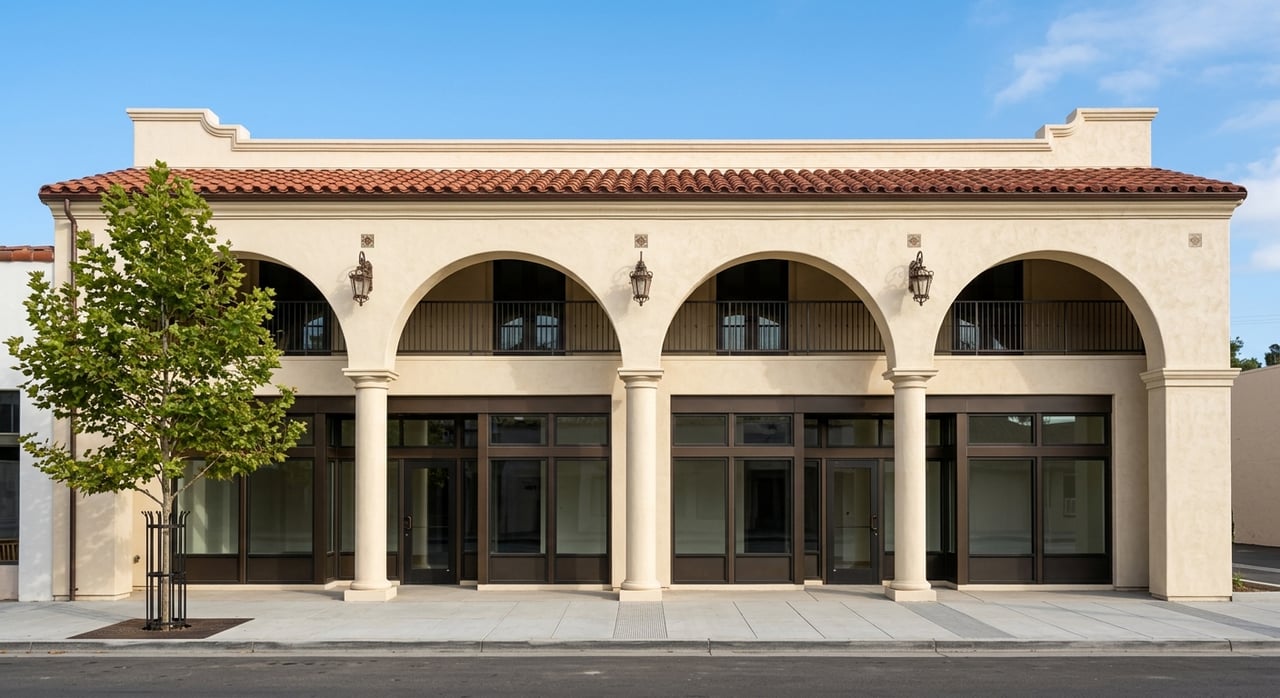
The city describes the Ojai Arcade as a historic Mission Revival structure fronting the downtown business district. Its pedestrian plans also identify the Arcade, connecting plazas, and the walkway along Libbey Park as high-service pedestrian facilities. For owners, that means frontage, foot traffic, and experience-driven uses can carry real weight in a use analysis.
Before you model rents or renovation costs, verify the parcel’s exact zoning and land use designation. In downtown Ojai, the most relevant commercial districts are C-1, B-P, and VMU, and each one points to a different range of likely outcomes.
C-1 is intended for community-serving and tourist-serving retail and service uses. The code includes general retail, personal services, hotels, and motels, which can make this district relevant for a range of commercial and hospitality strategies.
B-P is geared to the small-town, historic character of the downtown Arcade area. It includes offices, specialty retail, restaurants, cultural facilities, and bed and breakfasts, which makes it a strong fit for smaller-footprint, local-serving, and visitor-oriented programs.
VMU is intended for mixed-use residential and commercial development that supports pedestrian or bicycle transportation and community interaction. This district can be especially important for adaptive reuse or live-work concepts, but it also brings more design and parking scrutiny.
The first highest-and-best-use test is legal permissibility. On Ojai Main Street, that means your preferred use has to fit not only the use table, but also related rules on parking, growth allocation, design review, nonconforming status, and formula businesses.
In VMU, all property is subject to design review. Projects must satisfy design principles tied to context, continuity, human scale, and architectural quality, and the district is also tied to General Plan policies that promote pedestrian and bicycle access and community interaction.
Some new commercial uses may also require a growth allocation under the city’s Commercial Growth Management Plan. If your strategy depends on intensifying a site or re-tenanting with a more demanding use, this can affect timing and feasibility.
Existing nonconforming buildings and uses in VMU may continue, but later changes in use must comply with location and parking requirements. That makes it important to understand whether the current use is fully conforming, legally nonconforming, or vulnerable if a tenant turns over.
Ojai’s formula-business ordinance is a major filter for downtown tenant strategy. In the Downtown Commercial land use designation, a formula business cannot receive a conditional use permit if it has street-level frontage over 25 linear feet or usable area over 2,000 square feet.
The city defines formula business broadly, including restaurants, hotels and motels, and retail sales of goods when standardized features are present. In practical terms, that can make chain-style tenanting harder to execute downtown, especially for larger storefronts.
For many owners, this pushes value analysis toward independent operators, local concepts, and smaller-scale tenancy plans. A use that looks strong in another market may simply not be the best fit in Ojai’s regulatory and brand environment.
If you are evaluating hospitality use, it is important to separate regulated lodging from short-term rentals. The city states that vacation rentals are not legal in village mixed-use, while hotels, motels, and bed and breakfast establishments are exempt.
That means downtown lodging value generally has to come from an entitled hospitality format, not a vacation-rental-style model. For owners exploring adaptive reuse, this can materially change both underwriting and entitlement strategy.
The next test is physical possibility. This is where you ask what the parcel and building can actually support given its size, layout, access, parking field, frontage, circulation, and relationship to the pedestrian environment.
On Main Street, many properties perform best when they align with a walkable, human-scale pattern. Smaller bays, active storefronts, flexible interiors, and uses that benefit from foot traffic often match the physical reality better than large-format or car-first concepts.
Parking is often a decisive factor. In VMU, mixed-use parking can be reduced when residential use is up to, but not more than, 50 percent of total building area, but only with a site-specific parking study that accounts for shared use and design review approval.
The code also allows some parking modifications, such as covered or tandem parking, when they fit nearby development patterns and the operational characteristics of the use. That creates opportunity, but only where the site and the approval path support it.
A use is not financially feasible just because it commands a high nominal rent. It has to work after you account for tenant demand, buildout cost, entitlement friction, parking limitations, and the time needed to get to market.
In Ojai, local demand and visitor demand overlap. Because tourism supports specialty retail beyond what the resident population alone could support, some downtown uses can outperform what population size alone might suggest.
Still, the strongest candidates are often the ones that fit the corridor’s physical and regulatory constraints with the least friction. A modest concept that leases quickly, uses the building efficiently, and reinforces pedestrian activity may produce better risk-adjusted value than a more aggressive plan that struggles with approvals or parking.
Research points to several categories that are generally well aligned with Ojai Main Street. The common thread is that they tend to be small-scale, context-sensitive, and compatible with walkability and downtown character.
Specialty retail, artist studios, galleries, and related cultural uses fit well with Ojai’s downtown identity. The B-P district expressly includes specialty retail and cultural facilities, and the General Plan supports village mixed-use areas with limited retail, live-work opportunities, and cottage-style businesses.
Restaurants are expressly listed in B-P, and C-1 supports tourist-serving retail and service uses. In downtown Ojai, smaller footprints and experience-led food concepts are generally more consistent with the pedestrian setting and parking-sensitive environment than larger, auto-oriented formats.
Professional office, wellness, and personal-service uses are also credible options. C-1 allows personal services, B-P allows offices, and the General Plan contemplates low-intensity commercial uses such as lodging, realty, small medical, and other service-related office space.
Boutique lodging can work where zoning, building type, and entitlement line up. The code allows hotels and motels in C-1 and bed and breakfasts in B-P, which means some downtown hospitality strategies may be viable if they are structured as regulated lodging rather than short-term rentals.
Mixed-use or live-work redevelopment may be a strong long-term play on the right VMU parcel. The General Plan explicitly encourages living and working in the same building or location, but this path usually requires a more careful review of design, parking, and access than a standard commercial lease-up plan.
The final test is maximum productivity, which asks which feasible use produces the greatest value. In Ojai, the answer is often not the largest possible program.
The city’s emphasis on independent businesses, pedestrian orientation, small-town character, and preservation-sensitive public spaces tends to reward uses that are well matched to the district. In many cases, the most productive use is the one that protects character, controls parking demand, and supports consistent foot traffic.
That can mean a refined specialty retail mix, a smaller hospitality concept, office or wellness tenancy, or a measured mixed-use plan. It can also mean improving an existing building rather than pushing for a more intensive use that faces greater approval risk.
If you are evaluating a Main Street property, start with a disciplined review before making leasing or capital decisions.
For most Ojai Main Street properties, highest and best use is less about chasing the broadest tenant pool and more about matching the asset to the city’s downtown framework. Uses that reinforce walkability, respect character, and work within parking and design limits are more likely to hold value over time.
That is why a careful analysis often favors small-scale commercial, hospitality, office, or mixed-use programs over larger-format concepts that depend on chain branding, heavy parking demand, or a car-first layout. If you own a downtown asset, the best next step is usually a parcel-specific review that combines zoning analysis, physical constraints, tenant demand, and value-creation strategy.
If you are weighing leasing, repositioning, or disposition options for an Ojai Main Street property, Robert Rauchhaus can help you evaluate the asset through a strategic, confidential advisory process grounded in commercial real estate, hospitality, and value-creation planning.
Stay up to date on the latest real estate trends.
Learn more about commercial sales, leasing, business sales, M&A, and asset management.
Get In Touch With Our Team To Learn More
PO BOX 30766 SANTA BARBARA CA 93130