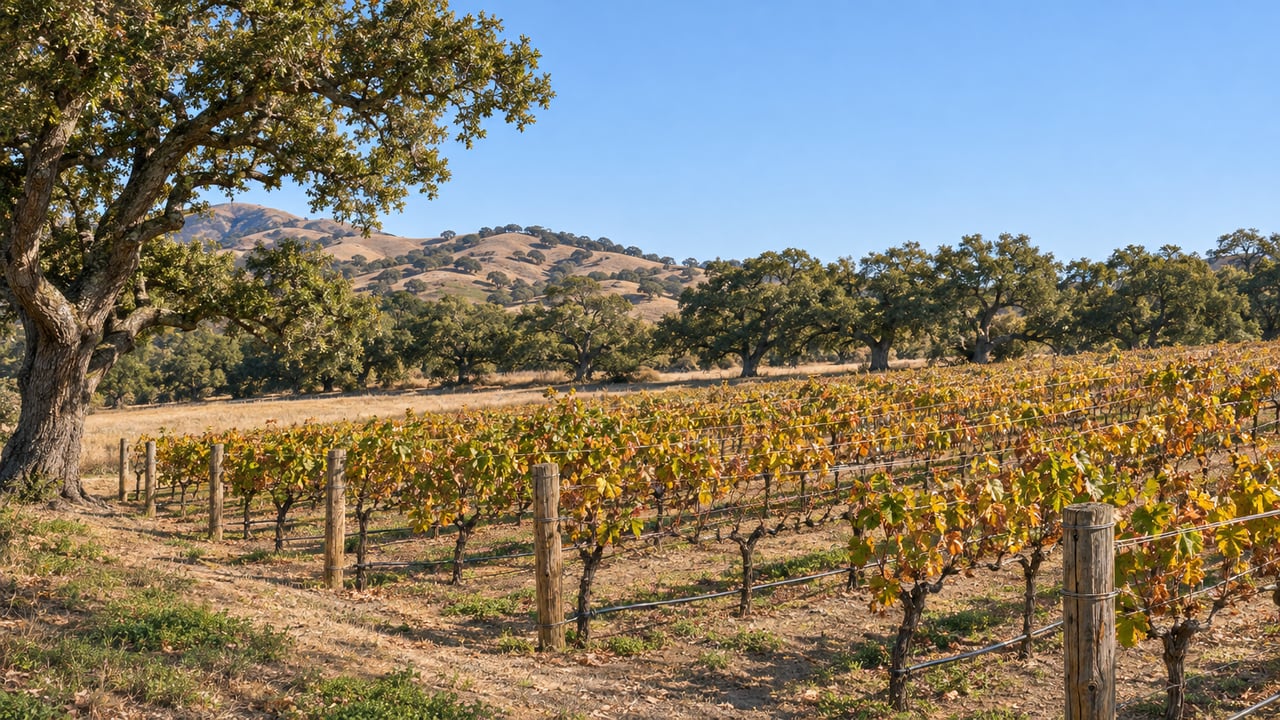
In the Santa Ynez Valley, a Vineyard's Pumping Record Is Becoming Part of What Sells
November 12, 2026
On a vineyard parcel in Santa Ynez, Los Olivos or Ballard, the groundwater charge appears on the Santa Barbara County property tax bill. Nobody read a meter to produce it. For agricultural parcels, the Eastern Management Area Groundwater Sustainability Agency estimates pumping "using a combination of current crop mapping and remotely sensed evapotranspiration data," then bills each parcel through the county tax roll for the water its crops are estimated to have needed.
That changes on June 30, 2027. After that date, every non-exempt well in the EMA must have a meter, and the valley's vineyards will begin producing a measured record of how much water they pump. The fee is small compared with what a vineyard sells for. The record is what matters in a sale. The GSA treats well registration data as confidential and open only to its staff, so the seller's own files carry weight in diligence. The GSA's adopted plan also lists historical groundwater production among the factors it would weigh if it ever sets pumping allocations.
Under the EMA GSA's fee FAQ, the fee took effect July 1, 2025. First-year charges were based on estimated groundwater production in Water Year 2024, which ran from October 1, 2023 through September 30, 2024. So when a parcel trades, the charge on the current tax roll can reflect pumping that happened before the buyer owned it, under the seller's planting and irrigation decisions. How that charge is handled between buyer and seller is a question for their own tax and legal advisers.
The rate is set per acre-foot and follows a five-year schedule the board adopted unanimously after a public hearing on June 26, 2025.
| Fiscal year | Extraction fee per acre-foot |
|---|---|
| FY 2025–26 | $39.50 |
| FY 2026–27 | $41.50 |
| FY 2027–28 | $43.60 |
| FY 2028–29 | $45.80 |
| FY 2029–30 | $48.10 |
These rates are ceilings. The GSA says it "does not have to increase the fee" on this schedule, and raising it above these rates would require a new rate study and a new Proposition 218 notice.
At the FY 2026–27 rate, a parcel estimated at 100 acre-feet of annual pumping pays $4,150. That is real money, but it is a small number when underwriting a vineyard. What matters more is the volume behind it: who measures that volume, who holds the record, and what the record might later be used for.
Well registration ran from July 1 to August 31, 2026 through Watermark, an online portal, and covered wells in the EMA, including inactive wells, abandoned wells and small domestic wells.
The EMA's registration and metering page says registration information "becomes the intellectual property of the EMA GSA and is only accessible by EMA GSA staff," and that it will be treated as confidential under applicable law and GSA policy.
That matters in a transaction. A buyer reviewing a vineyard can pull the title report, the crop history and the tax bill. Under that statement, the parcel's well registration is open to GSA staff, which makes the seller's own copy the practical starting point for a buyer's review. Two other details shape the transaction:
The EMA's well metering and reporting ordinance, Ordinance No. 2025-03, requires a flow meter accurate to within plus or minus 5 percent, with a rate indicator and a visible totalizer, installed by June 30, 2027. Operators must record the totalizer reading every month and file extraction reports twice a year, on April 30 and October 31. The first report is due October 31, 2027.
The GSA does not publish a cost estimate. It says costs vary with meter size, well type and labor, and it refers owners to local pump vendors. The Santa Barbara County Water Agency's Well Metering Assistance Program offers up to $500 to qualifying landowners toward buying and installing a meter.
The GSA says registration, metering and reporting "will provide more accurate water usage information for future monitoring and fee calculations." The adopted plan points to a further use.
The adopted Groundwater Sustainability Plan, dated January 2022 and approved by the California Department of Water Resources on January 18, 2024, sorts its tools into groups. Fees, well registration, metering and water-use efficiency are Group 1 actions, to be started first. A Groundwater Base Pumping Allocation program is a Group 2 action, along with a program for trading groundwater extraction credits.
The plan describes allocation as conditional. If Group 1 actions "do not avoid chronic groundwater level declines and reduction of groundwater in storage over the next 20-year period and beyond," the GSA "may seek to develop and implement" an annual allocation, and the size of any reduction "is uncertain." Before any allocation could take effect, the plan requires a method for setting baseline pumping that considers:
Sustainable yield of the EMA; Groundwater level trends; Historical groundwater production; Land uses and corresponding water use requirements; Compliance with the California Environmental Quality Act
It also requires an implementation timeline and a formal regulation. No allocation has been adopted or scheduled. The GSA's August 2026 draft periodic evaluation says Group 2 actions "remain available for future implementation as conditions warrant."
The basin figures explain why the option remains in the plan. The GSP estimated that from 1982 through 2018, outflow exceeded inflow by an average of 1,830 acre-feet a year, against a sustainable yield of about 12,870 acre-feet a year. It projected a deficit of 2,060 acre-feet a year in 2042 if nothing is done to add supply or reduce demand. The draft periodic evaluation reports that storage rose by roughly 6,000 acre-feet in wet Water Year 2024 but still shows a net cumulative decline of about 15,200 acre-feet since 2015. It also reports that water levels fell below minimum thresholds in 50 percent or more of wells during several individual seasons, but never for the two consecutive years needed to trigger an undesirable result.
The trigger itself may change. In response to a corrective action DWR requested, the draft lists possible plan amendments, including removing non-drought-year contingencies from the definition of undesirable results for groundwater levels and moving to seasonal fall monitoring criteria.
Put those facts together and the meter matters for more than billing. A seller's pumping records can be part of a buyer's review.
Several decisions are still pending. The GSA board's September 24, 2026 agenda included approval of the periodic evaluation and a plan amendment addressing two of DWR's recommended corrective actions. It also included direction on a possible extension of the August 31 registration deadline and possible penalties for unregistered wells, and direction on de minimis determinations for metering and on policies for shared wells. The draft evaluation is due to DWR by January 19, 2027.
The board has a special meeting scheduled for November 19, 2026 at 4:00 p.m. at the Santa Ynez Community Services District meeting room, 1070 Faraday Street. A basin-wide joint special meeting is set for December 11, 2026 at 9:00 a.m. in the Buellton City Council Chambers.
For a seller, a well-organized water file usually includes the following:
The EMA GSA can be reached at (805) 457-5065 or [email protected]. Have the property address or APN ready.
This post is general information about published agency rules. It is not legal, tax or financial advice, and owners and buyers should confirm how these rules apply to a specific property with their own attorney, accountant or water professional.
When a vineyard's value depends partly on its water history, organizing that file is part of preparing the sale. Robert Rauchhaus advises Santa Ynez Valley vineyard and ranch owners on valuation, diligence readiness and sale strategy. Schedule a confidential consultation to discuss strategy and valuation.
Stay up to date on the latest real estate trends.
Learn more about commercial sales, leasing, business sales, M&A, and asset management.
Get In Touch With Our Team To Learn More
PO BOX 30766 SANTA BARBARA CA 93130